 Our Offices: London | Manchester | Open 7 Days

UK English Language Requirement for Work Visas 2026 | B2 Changes


UK English Language Requirement for Work Visas: 2026 Changes Explained
If you’re planning to work in the UK or you’re already here on a work visa, you need to know about the changes to English language requirements that came into force in January 2026. The rules have tightened, and what worked for your colleague last year might not be enough for your application this year.
The Home Office has raised the bar for several popular work visa routes, moving from B1 to B2 level English. This isn’t just a minor tweak it affects how you prepare, which tests you take, and when you need to book them. Getting this wrong can delay your visa, cost you money, and potentially derail your UK plans altogether.
Whether you’re applying for the first time or helping someone through the process, this guide breaks down exactly what’s changed, who’s affected, and what you need to do to meet the new requirements. We’ll cover everything from understanding CEFR levels to choosing the right English test, and we’ll look at which visa routes have changed and which haven’t.
What’s Changed with the UK English Language Requirement in 2026?
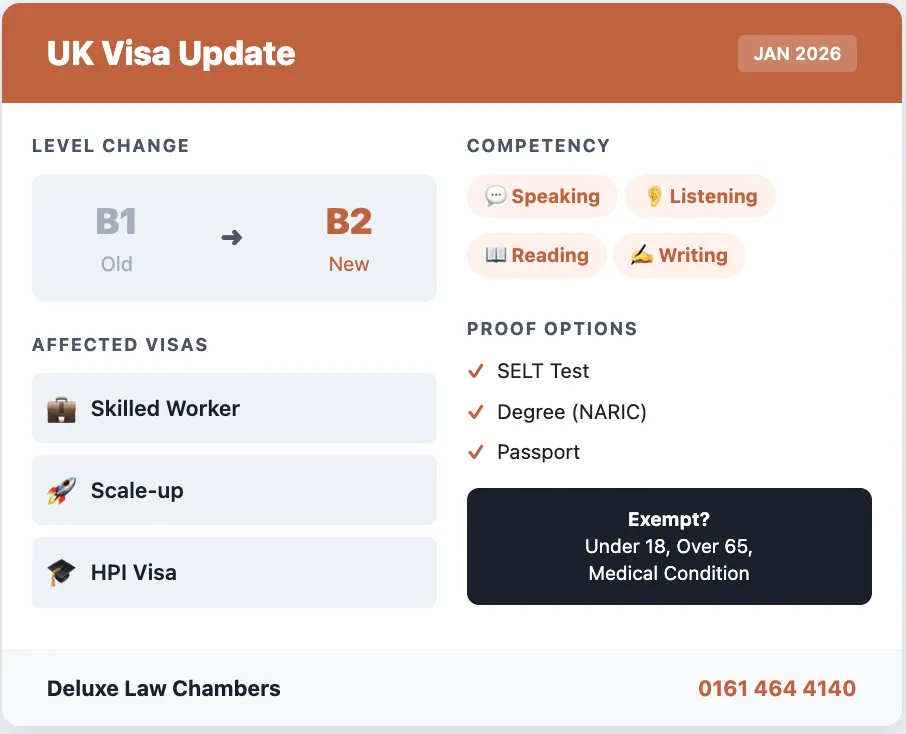
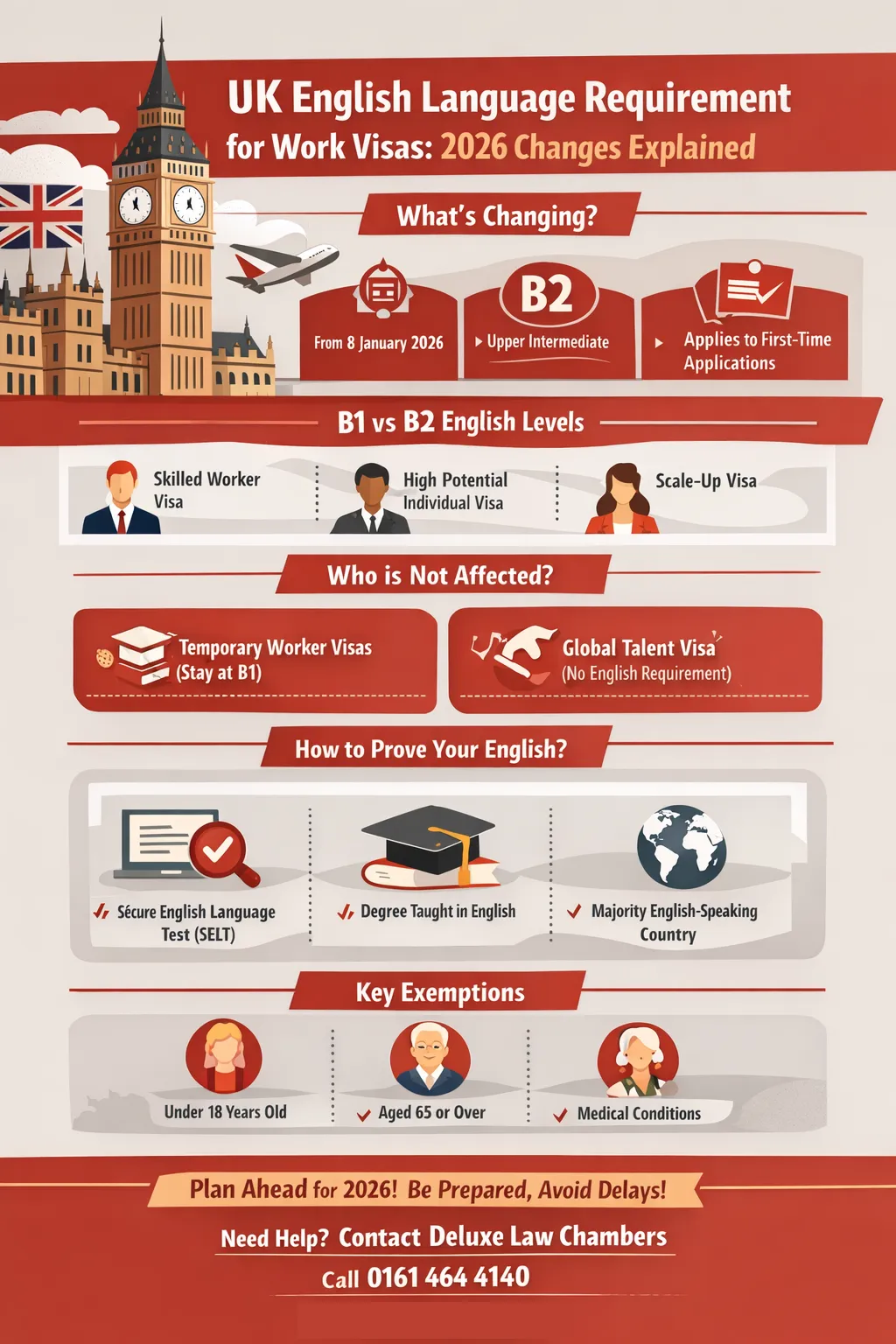
From 8 January 2026, the English language requirement increased to B2 level (roughly A-Level equivalent) for new applications under three major work visa categories: Skilled Worker, High Potential Individual, and Scale-up visas. Previously, these routes required B1 level (GCSE equivalent), which is a lower standard.
This change applies specifically to first-time applications made on or after 8 January 2026. If you’re extending an existing visa or you’ve already got leave under one of these routes, you’ll follow the English requirements that apply to your specific extension or settlement stage – and these haven’t necessarily changed.
The shift to B2 means you need to demonstrate competence across all four language skills: speaking, listening, reading, and writing. You can’t just be conversational anymore you need to show you can handle more complex language situations, whether that’s following detailed discussions at work, reading technical documents, or writing professional correspondence.
It’s worth noting that the application date is what counts here, not when you received your job offer or when your employer assigned your Certificate of Sponsorship. If your application goes in on 8 January 2026 or later, you’re subject to the B2 requirement. That means planning ahead and getting your English evidence sorted early is more important than ever.
Which UK Work Visas Are Affected by the English Language Changes?
Not all work visas have been hit with the same changes. Some routes now require higher English standards, whilst others have stayed exactly as they were. Understanding which category your visa falls into will save you time and help you prepare properly.
Skilled Worker Visa English Requirements
The Skilled Worker visa is probably the most widely used sponsored work route, and it’s one of the three affected by the January 2026 changes. If you’re making a new Skilled Worker application on or after 8 January 2026, you need to meet the B2 English language requirement.
This applies right at the start when you’re applying for your first grant of permission. Once you’re in the UK on a Skilled Worker visa and you come to extend it, the English requirement for that extension follows its own rules – which may or may not require you to prove English again, depending on what evidence you used initially.
You can meet the requirement in several ways. The most common is passing a Secure English Language Test with a UKVI-approved provider at B2 level. Alternatively, if you have a degree that was taught or researched in English and meets Home Office recognition standards, you can use that instead. Nationals from certain majority English-speaking countries are also exempt from having to take a test.
Some people don’t need to prove their English at all. Children under 18, applicants aged 65 or over, and those with physical or mental conditions that prevent them from meeting the requirement can be exempt from this rule.
High Potential Individual (HPI) Visa English Standards
The High Potential Individual visa is designed for recent graduates from top global universities. It’s not a sponsored route, which gives applicants a bit more freedom, but it’s still caught by the new B2 requirement.
If you’re applying for an HPI visa on or after 8 January 2026, you’ll need to demonstrate B2 level English across all four skills. This is a step up from the previous B1 requirement and reflects the government’s intention to ensure that high-calibre graduates have strong language skills to match their academic credentials.
Because HPI applicants aren’t tied to a specific employer, the responsibility for arranging and paying for English tests sits entirely with you. There’s no sponsor to guide the process, so you need to be organised about booking your test, making sure it’s the right type, and getting your results back in time for your application.
Scale-up Visa Language Requirements
The Scale-up visa is a newer route aimed at fast-growing UK businesses. It allows you to work for a sponsor initially, then gives you flexibility to change employers after six months. Like the Skilled Worker and HPI routes, it’s now subject to the B2 English requirement for new applications made from 8 January 2026.
The uplift applies only to your initial application. If you’re already in the UK on a Scale-up visa and you’re extending or switching, you’ll need to follow whatever English rules apply to that particular stage of your immigration journey.
Temporary Worker Visas (Unchanged)
Good news if you’re looking at a Temporary Worker visa: these routes haven’t changed. They still operate at B1 level for reading, writing, speaking, and listening. This includes categories like the Creative Worker visa, Charity Worker visa, and Religious Worker visa.
The government has kept the Temporary Worker routes at B1 because they’re designed for shorter stays and more limited purposes. If you’re coming to the UK for a few months or a couple of years under one of these routes, you won’t face the higher B2 threshold.
Global Talent Visa (No English Requirement at Entry)
Here’s an interesting one: the Global Talent visa doesn’t have an English language requirement at the entry stage at all. If you’re applying as a leader or potential leader in academia, research, arts, culture, or digital technology, you’re assessed on your endorsement or prize criteria, not your language ability.
English only becomes relevant later down the line if you decide to apply for settlement or British citizenship. At that point, you’ll need to meet the B1 standard for Indefinite Leave to Remain, but that’s years away from your initial application.
For employers recruiting under Global Talent, this means the January 2026 changes have zero impact on visa eligibility. Of course, you’ll still want to make sure your hire can function effectively in an English-speaking workplace, but that’s a practical business consideration rather than a visa requirement.
Understanding CEFR English Language Levels for UK Visas
The UK immigration system uses the Common European Framework of Reference for Languages (CEFR) to define English standards. It’s a six-level scale that ranges from A1 (beginner) to C2 (mastery), and it’s used across Europe to create consistency in how language ability is measured and recognised.
What is B2 English Language Level?
B2 is classed as “upper intermediate” English. At this level, you should be able to understand the main ideas in complex texts on both concrete and abstract topics. You can interact with a degree of fluency and spontaneity that makes conversation with native speakers fairly natural, and you can produce clear, detailed text on a wide range of subjects.
In practical terms, B2 English means you can follow a meeting at work even when the discussion gets technical or nuanced. You can read and understand reports, articles, and professional correspondence without constantly reaching for a dictionary. You can write emails, summaries, and documents that are coherent and appropriately structured, and you can argue a point of view in conversation, giving the advantages and disadvantages of different options.
This is noticeably more demanding than B1, where the focus is on familiar, everyday situations. B2 asks you to handle language in more sophisticated and less predictable contexts.
B1 vs B2: What’s the Difference?
The jump from B1 to B2 is significant, even though it’s only one level up. At B1, you can deal with most situations you’re likely to encounter whilst travelling in an English-speaking country. You can describe experiences, events, dreams, and ambitions, and you can briefly give reasons and explanations for opinions and plans.
B2 takes it further. You’re expected to engage with more abstract ideas, understand implicit meaning, and express yourself fluently without obviously searching for words. The difference shows up in workplace situations: a B1 speaker might manage a simple conversation about their job role, whilst a B2 speaker can discuss company strategy, analyse problems, and participate fully in professional discussions.
For visa purposes, the practical impact is that you might need more preparation time to reach B2 if your English is currently at B1. Many people underestimate this and end up having to retake their test, which costs more money and delays their application.
How to Prove Your English Language Ability for UK Visas
Meeting the English requirement is about more than just speaking English well – it’s about providing the right evidence in the right format. UKVI is strict about what it accepts, and evidence that doesn’t match the route requirement at the date of your application will be rejected.
Secure English Language Tests (SELT)
A Secure English Language Test is the most common way to prove your English. These are specific tests offered by Home Office-approved providers, and they have to be taken at approved test centres with strict security measures in place.
The main SELT providers are IELTS for UKVI (offered by IDP and British Council), LanguageCert, Pearson PTE, and Trinity College London. Each offers tests at different CEFR levels, so you need to book the test that matches your visa requirement – in this case, B2 for the affected work routes.
You can’t just take any English test and expect it to count. Academic IELTS, for instance, isn’t accepted for visa purposes even though it’s widely recognised for university admissions. It has to be IELTS for UKVI specifically. Similarly, old test results or tests from non-approved providers won’t work, no matter how high your score was.
Booking well in advance is sensible. Test centres can get busy, particularly in major cities and at certain times of year. If you need to retake the test because you didn’t quite hit B2 on your first attempt, you’ll need time to book another slot and get your results before your application deadline.
Using Academic Qualifications as English Proof
If you have a degree that was taught or researched in English, you might be able to use this instead of taking a test. The qualification needs to be recognised by UK NARIC (the National Recognition Information Centre for the UK) or be from an institution on the Home Office’s list of recognised bodies.
This option works well for people who studied their undergraduate or postgraduate degree in English at a recognised university, whether in the UK or abroad. You’ll need to provide your original degree certificate and an official letter from the university confirming that the course was taught in English.
There’s a bit of a catch: not all English-taught degrees are automatically accepted. If your degree is from outside the UK, you may need to obtain a statement of comparability from UK NARIC, which can take several weeks and costs money. This isn’t always straightforward, so if you’re planning to rely on your degree, start the verification process early.
English-Speaking Country Nationals
If you’re a national of a majority English-speaking country, you’re automatically treated as meeting the English language requirement. The list includes countries like the United States, Canada, Australia, New Zealand, and several Caribbean nations.
This exemption is based on nationality, not where you currently live or where you grew up. So if you hold a passport from one of these countries, you don’t need to take a test or provide academic evidence – your passport is sufficient.
It’s worth double-checking the official list because it’s more limited than you might think. South Africa, for instance, isn’t on it despite having English as one of its official languages. If you’re unsure whether your country qualifies, the Home Office publishes the complete list in its guidance documents.
Who is Exempt from English Language Requirements?
Not everyone has to prove their English, even under the tighter B2 rules. If you’re under 18 or aged 65 or over, you’re automatically exempt. This recognises that very young people are still developing language skills and that older applicants may face additional challenges with formal testing.
There’s also an exemption for people with a physical or mental condition that prevents them from meeting the requirement. This isn’t automatic – you need to provide medical evidence from a qualified professional explaining why you can’t take a test or provide the usual evidence. The condition has to be long-term and genuinely prevent you from demonstrating your English ability through normal channels.
These exemptions are applied on a case-by-case basis, and the Home Office will want to see proper documentation. If you think you might qualify for an exemption, it’s worth getting advice before you submit your application to make sure you’re providing everything needed.
English Language Requirements for Other UK Visa Routes
The B2 changes that came in during January 2026 only affect certain work routes. Other visa categories have their own English requirements, and understanding these can help you work out the full picture if you’re planning a longer stay in the UK or if family members are joining you.
Family and Partner Visa English Requirements
If you’re applying to join a partner or spouse in the UK, the English requirements are lower than for work visas. Initial applications under Appendix FM require A1 level English in speaking and listening only – that’s basic everyday language, not the more advanced B2 standard.
When you extend your partner visa after 30 months, the requirement steps up to A2, which is still elementary but shows some progress. For settlement after five years on the partner route, you’ll need to meet B1 in speaking and listening, along with passing the Life in the UK test.
These staged requirements are designed to give family migrants time to improve their English gradually whilst living in the UK. It’s less demanding than the work visa requirements because the policy recognises that family members may not have the same immediate need for professional-level English.
Dependant Visa Language Rules
Right now, dependants of work visa holders don’t face any English language requirement at all. That means your spouse, partner, or children under 18 can join you in the UK without needing to take a test or prove their English ability.
However, this could change. The government has indicated that dependants might be required to prove B1 level English in the future, though no specific date has been set. If this happens, it would bring dependant visas more in line with the general trend towards higher English standards across the immigration system.
For now, though, if you’re bringing family members with you on your work visa, English isn’t a barrier at the application stage – though of course, practical considerations like schooling and daily life mean having some English is still helpful.
Settlement (ILR) English Requirements
When you’re ready to apply for Indefinite Leave to Remain after several years in the UK, you’ll need to meet B1 level English in speaking and listening. This applies to most settlement routes, including those coming from Skilled Worker, Global Talent, and family visas.
You’ll also need to pass the Life in the UK test, which is a separate requirement that tests your knowledge of British history, culture, laws, and customs. The test is in English, so you need reasonable English skills even to sit it, let alone pass.
Age exemptions apply here too: if you’re under 18 or aged 65 or over when you apply for settlement, you won’t need to prove B1 English or take the Life in the UK test. Disability exemptions are also available with appropriate medical evidence.
It’s important to keep your English certificates safe once you’ve taken them. SELT results are usually valid for two years, but some applicants find they need to retake tests if too much time has passed between their initial visa and their settlement application.
What the Changes Mean for Visa Applicants
The move to B2 English has practical implications beyond just the difficulty of the test itself. It affects timelines, costs, and how you plan your move to the UK.
Timeline and Planning Considerations
The single biggest issue is timing. Your application date determines which English requirement applies not when you got your job offer, not when your Certificate of Sponsorship was assigned, but when your visa application actually goes in.
If you’re cutting it close to 8 January 2026 or you’re applying after that date, you need to factor in time to book a B2 level test, sit it, get your results, and potentially retake it if you don’t pass first time. Test results typically take between two days and two weeks depending on the provider and test type.
This isn’t something you want to leave until the last minute. Test centres can be booked up weeks in advance, particularly in cities with large migrant populations. If you miss your slot or need a retake, you could be looking at another month before you can submit your visa application, which can throw off start dates and work plans.
Common Challenges and How to Overcome Them
One of the most common mistakes is booking the wrong test. Taking an academic IELTS instead of IELTS for UKVI, or booking a B1 test when you need B2, means your result won’t be accepted and you’ll have to start again. Always double-check you’re booking the correct test type and level before you pay.
Test availability is another frequent problem. Popular centres in London, Manchester, Birmingham, and other major cities often have limited slots, especially on weekends. If you’re flexible on location, you might find more availability in smaller cities or towns.
Some people struggle with one particular skill – often writing or speaking – and end up just below the B2 threshold. If this happens, targeted preparation on your weak area before a retake can make the difference. Many test providers offer practice materials, and there are plenty of online resources designed specifically for IELTS, PTE, and other SELT tests.
Impact on UK Employers and Recruitment
If you’re a UK employer who sponsors workers from overseas, the B2 change adds another layer to your recruitment process. It doesn’t create new compliance obligations for you as a sponsor, but it does affect your hiring timelines and the candidates you can successfully bring in.
Sponsorship Implications
The English language requirement sits with the applicant, not the sponsor. You’re not legally responsible for verifying their English evidence in the same way you are for right to work checks. However, in practice, a refused application because of insufficient English still disrupts your workforce planning.
From a recruitment perspective, you need to build English testing into your hiring timelines earlier than before. If you’re making offers to candidates who’ll need to prove B2 English, flag this requirement at the offer stage and encourage them to book their test immediately. Waiting until the Certificate of Sponsorship is assigned is too late.
Costs have gone up too. The Immigration Skills Charge increased in December 2025, which applies on top of the visa fees themselves for most Skilled Worker sponsorships. Combined with potentially more expensive English tests (B2 tests can cost £10-30 more than B1 tests), the overall cost of bringing someone in from overseas has crept up.
Alternative Visa Routes to Consider
The B2 requirement only affects certain routes, so it’s worth considering whether alternative visas might work better for particular roles or candidates. Global Talent, for instance, has no English requirement at entry and might suit senior or specialist hires who meet the endorsement criteria.
For recent graduates from top universities, the High Potential Individual route is affected by B2, but the Graduate route isn’t though that’s only available to people who’ve already studied in the UK. The Graduate route is also shortening to 18 months for new entrants from January 2027, which narrows the window for employers using it as a pathway into sponsored roles.
If you regularly recruit internationally, it’s worth getting advice on route strategy rather than defaulting to Skilled Worker for everyone. Different routes have different costs, different timelines, and different flexibility, and the right choice depends on the specific circumstances of the role and candidate.
Future Changes to English Language Requirements
The January 2026 uplift isn’t necessarily the end of the story. The government has signalled that higher English requirements could extend to more visa categories over time.
One area to watch is dependants. There’s been political discussion about requiring dependants to prove B1 English before they can join family members in the UK, though no firm date has been set for this. If it happens, it would represent a significant shift from the current position where dependants face no English requirement at all.
There’s also the possibility that other work routes currently at B1 might move to B2 in the future. Routes like the various Global Business Mobility categories haven’t been touched by the January 2026 changes, but that doesn’t mean they’re permanently protected from future uplifts.
For anyone planning a long-term stay in the UK, keeping an eye on Immigration Rules changes is sensible. The Home Office usually announces major changes with at least a few weeks’ notice, but not always with much more than that. Following immigration law updates or working with an adviser who tracks these changes can help you stay ahead of new requirements.
Getting Legal Help with UK Visa English Requirements
Immigration rules are complicated, and they change regularly. Working out which English requirement applies to your specific situation, which test to take, and how to gather all your evidence correctly can be stressful and time-consuming.
A qualified immigration adviser can review your circumstances and confirm exactly what you need. They can tell you whether your degree will be accepted as English evidence, or whether you’re better off taking a test. They can check that you’re booking the right SELT at the right level, and they can make sure your application is put together properly so you don’t face unnecessary delays or refusals.
This is particularly important if your situation is complex – for instance, if you’re switching between visa routes, if you’ve had previous refusals, or if you’re trying to work out whether you qualify for an exemption. Getting it wrong can cost you months and significant money, so professional advice often pays for itself.
Confused about the new English language requirements for your UK visa application?
The rules have changed, and getting it wrong could mean delays or refusal. Our immigration specialists at Deluxe Law Chambers can review your situation, confirm which English level you need, and make sure your application meets all current requirements. Call us on 0161 464 4140 or book your appointment online for expert guidance on your visa application.
Why Choose Deluxe Law Chambers?
Deluxe Law Chambers offers expert, affordable, and reliable immigration support with tailored services, quick visa options, online or in-person advice, and free initial consultation available seven days a week.
- Expert Immigration Solicitors – With years of experience, we stay up to date with the latest UK immigration laws to give you the best legal advice.
- Five Star Google Reviews – Rated 5 Star Google Reviews by 99% of our satisfied clients, reflecting our commitment to trusted, high-quality, and client focused immigration services.
- Personalised Service – Every case is unique. We offer tailored solutions based on your individual circumstances.
- Fast & Reliable Visa Services – Need a quick decision? We offer Priority and Super Priority visa services for faster processing.
- Remote Legal Support – Our solicitors can handle your case online, saving you time and travel costs.
- In person Support – You can also visit our Manchester office or London Office for in-person advice.
- Open 7 Days a Week – We provide expert immigration advice every day, including weekends.
- Free Immigration Advice – Get a 5-minute free phone consultation.
- Fixed Fees with Instalments – No hidden costs! We offer affordable fixed fees, with the option to pay in two instalments.
What English level do I need for a Skilled Worker visa in 2026?
If you’re making a new Skilled Worker visa application on or after 8 January 2026, you need B2 level English across all four skills (speaking, listening, reading, writing). This is higher than the previous B1 requirement. Extensions of existing Skilled Worker visas follow their own rules and may not require you to prove English again.
Do I need to retake my English test if I’m extending my visa?
Not necessarily. When you extend a visa, the English requirement depends on the specific rules for that extension stage. In many cases, if you’ve already proven English for your initial grant, you won’t need to prove it again for an extension. However, this varies by route and by what evidence you used originally.
Can I use an old English test certificate for my 2026 application?
SELT certificates are usually valid for two years from the date you took the test. If your certificate is still within that validity period and it shows B2 level or higher across all four skills, it should be acceptable. However, you need to make sure the test was a Secure English Language Test from an approved provider.
Which English tests are accepted by the Home Office?
The Home Office accepts Secure English Language Tests from approved providers including IELTS for UKVI (British Council and IDP), Pearson PTE, Trinity College London, and LanguageCert. Standard academic IELTS and other general English tests are not accepted for visa purposes.
What happens if I fail my English language test?
If you don’t achieve B2 across all four skills, you can retake the test. Most providers let you book a new test as soon as you receive your results. However, retakes cost the same as the original test and you’ll need to factor in booking availability and results processing time.
Do dependants need to prove English language ability?
Currently, dependants of work visa holders do not need to prove English ability at all. However, the government has indicated this could change in the future, with a possible requirement for B1 level English for dependants, though no date has been set.
Are there exemptions for older applicants?
Yes, if you’re aged 65 or over at the time of your visa application, you’re exempt from the English language requirement. There are also exemptions for applicants under 18 and for those with physical or mental conditions that prevent them from meeting the requirement, provided appropriate evidence is supplied.
How much does a Secure English Language Test cost?
Prices vary by provider and test location, but SELT tests typically cost between £150 and £200. B2 level tests can be slightly more expensive than B1 tests. Additional services like faster results or retakes will add to the cost, so budget accordingly when planning your visa application.
Is IELTS accepted for UK work visas?
Yes, but it must be IELTS for UKVI, not academic IELTS. IELTS for UKVI is a Secure English Language Test and is accepted by the Home Office. You need to take the test at an approved test centre, and you must achieve B2 level in all four skills for the affected work visa routes.
How long does a SELT certificate last?
SELT certificates are typically valid for two years from the test date. This means you can take your test up to two years before your visa application and still use the results, as long as the certificate hasn’t expired when you submit your application.
Can I use my UK degree as proof of English?
Yes, if your degree was taught or researched in English at a recognised institution. You’ll need your original degree certificate and a letter from the university confirming the course was taught in English. Degrees from outside the UK may require verification from UK NARIC to confirm they meet the required standard.
What if I’m from an English-speaking country?
If you hold nationality from a majority English-speaking country (such as the USA, Canada, Australia, New Zealand, or certain Caribbean nations), you’re automatically exempt from proving English. Your passport serves as sufficient evidence, and you don’t need to take a test or provide academic qualifications.


